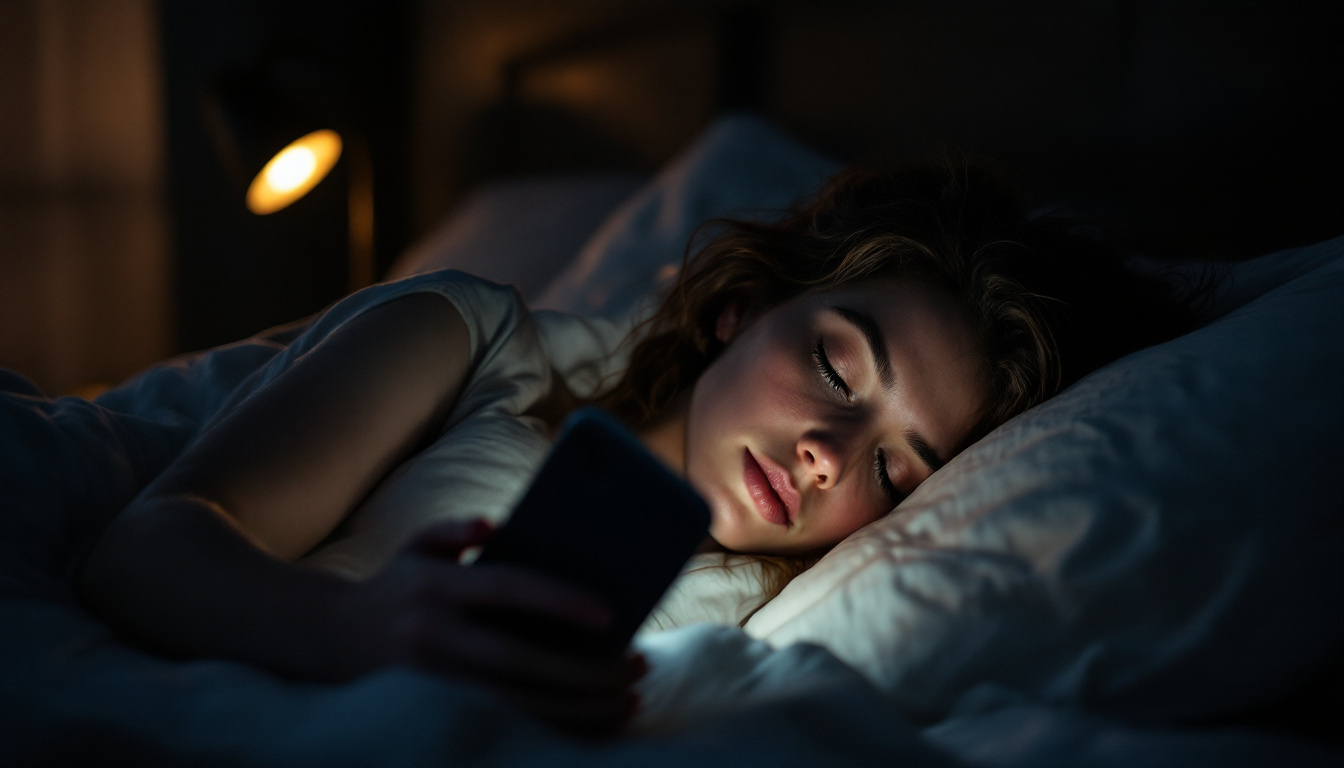
The same screen last thing at night, first thing in the morning
For many of us, the last thing we see before falling asleep and the first thing we see when we wake up are exactly the same: the phone screen. It sits on the nightstand, it wakes us up, it follows us into bed. And somewhere in the back of the mind there's a nagging feeling that this probably isn't good for our sleep.
That feeling isn't pulled out of thin air. Study after study shows evening screen use co-occurring with later bedtimes and worse self-reported sleep. So the question isn't whether screens and sleep are connected — in the data, they are. The interesting question is what about screen use drives the connection.
Here, the story has changed in recent years. The early narrative was almost entirely about blue light: the screen's light was said to trick the brain into thinking it's daytime and suppress the sleep hormone melatonin. That wasn't made up — the mechanism exists. But the advice ran ahead of the evidence. Early lab findings, produced under conditions that resemble few people's actual evenings, were extrapolated into broad recommendations about night modes and blue-light filters. As better studies have been done, the picture has sharpened: the light effect from an ordinary screen appears to be smaller than once thought, while delayed bedtimes and engaging content — the scrolling, the notifications, 'one more episode' — appear to carry more weight.
That doesn't mean screens are harmless for sleep. It means that if you want to understand the connection — and do something about it — you need to look at the right part of it. This article is a deep dive within the sleep cluster; for the big picture of how sleep connects to the rest of your health, see Sleep — how it connects to the rest of your health.
What does the light actually do?
Short version: light is the body's strongest time signal. When the eyes register light late in the evening, the internal clock interprets it as the day still being underway, and the clock can shift later. The evening rise in melatonin, which normally occurs at night, can be dampened and delayed. That mechanism is established physiology — the full walkthrough of how the internal clock, the light receptors in the eye, and timing work is in Morning light — why it governs your sleep, so we won't duplicate it here.
What often gets forgotten is the dose. A phone or tablet screen at normal brightness delivers on the order of a few dozen lux at the eye. Ordinary indoor lighting in the evening is often in the hundreds of lux, and outdoor daylight in the thousands or tens of thousands. In terms of light, the screen is a fairly weak player in the room — often weaker than the ceiling light shining at the same time.
That doesn't mean screen light is irrelevant. Sensitivity to evening light varies between individuals, and a bright screen close to the face in an otherwise dark room is the situation where the light component plausibly matters most. But it explains why newer research finds smaller light effects than the early narrative suggested: the screen's light is rarely the dominant light source in an evening, and it is definitely not the only one.
What does the research show — and what has changed?
The problem wasn't that the study was bad — it was well conducted. The problem was that a clear lab effect under extreme conditions was translated into broad everyday advice as if the effect were large and general. The evidence was thin, and the advice ran ahead of it.
What later reviews show. As the research field matured and more studies could be weighed together, the picture became more nuanced. Silvani, M.I., Werder, R. & Perret, C. (2022), in a systematic review in Frontiers in Physiology, examined the research on blue light and sleep in young adults: effects exist, but they are smaller and more mixed than the popular narrative suggested, and several studies find small or no effects of blue-light exposure or blue-light filtering on sleep outcomes.At the same time, another line of research pointed toward something more interesting. Brautsch, L.A.S. et al. (2023), in Sleep Medicine Reviews, synthesized the research on digital media use and sleep in older adolescents and young adults. The pattern there: the associations between screens and sleep appear to be driven more by how and when screens are used than by the light itself. Screen use in bed and interactive use late in the evening are associated with worse sleep outcomes to a greater degree than screen time in general.
Where it seems to happen: time and arousal. Two mechanisms emerge as the likely main tracks. The first is simple displacement — the screen pushes bedtime later. The phenomenon has its own research name, bedtime procrastination: Kroese, F.M. et al. (2014) described in Frontiers in Psychology how people delay their bedtime without external reasons, even though they know it will cost them — and that this procrastination is associated with shorter sleep and more daytime fatigue. The evening screen is an almost perfect machine for exactly that: endless feeds, autoplay, one more notification.The second mechanism is mental arousal. Here, what you do seems to matter. Passively watching something calm is, in studies, more weakly linked to sleep problems than engaging, interactive content — scrolling through social feeds, messages demanding replies, gaming, or binge-watching where the next episode starts on its own. Exelmans, L. & Van den Bulck, J. (2017) observed that heavy binge viewing in the evening was associated with worse sleep quality and more trouble falling asleep, and that pre-sleep cognitive arousal appeared to be part of the explanation — a brain still churning over the plot is not ready to wind down.
Summing up the current state. The light component is real but small under everyday conditions. The time and arousal components appear to be larger, and that is likely where most of the associations in population data live. The research points consistently in that direction, but the field is largely built on observational data and self-reported sleep — so the conclusions are held as associations, not proven causal chains. The screen doesn't 'destroy' sleep. But it often steals sleep — through time and mental revving rather than through lux.What's worth trying?
No finger-wagging here — most people already know they 'should' spend less time on screens in the evening. The interesting part is aiming the effort at what the research points to as the heaviest factors: time and arousal. Think of these as experiments to run for a couple of weeks, not rules.
- Notifications off in the evening. Much of evening screen use isn't started by your own decision but by a signal from outside. Many people find that a simple do-not-disturb setting from a certain time removes most of the involuntary screen sessions.
- A screen-free last half hour — as a two-week experiment. Not primarily for the light's sake, but to give your mental revs a chance to drop and your bedtime a chance to hold. Try it for two weeks and compare how falling asleep feels. Many people notice a difference; some don't — and then you've learned something about yourself.
- The charger in another room. Perhaps the simplest structural fix: if the phone isn't within reach of the bed, both the last scroll and the first one disappear. A regular alarm clock solves the morning.
- Lower brightness and night mode — reasonable, but not miraculous. Turning down brightness in the evening is a sensible low-cost measure. But be honest with yourself about what it does: the filters address the light component, which appears to be the weaker part of the connection. A warm-toned feed that keeps you up until 12:30 a.m. is still a feed that kept you up until 12:30 a.m.
- Change the content rather than banning the screen. If screen-free feels unrealistic: many people find that shifting from interactive to passive — from feeds and messages to something calm and predictable — makes the evening less wound-up, even with the screen still on.

Cipoli analysis
Cipoli's interpretationIn Cipoli's model, evening screen use is rarely an isolated factor — it is often a visible marker of how the whole evening is structured. In the assessment, we therefore look less at screen time as a number and more at the patterns around it: how regular the bedtime is, what the last hour of the evening looks like, and whether there is a clear boundary between the day's activation and the night's wind-down.
A pattern we often see in observations: people who rate their sleep poorly rarely describe the screen itself as the problem — they describe evenings with no clear end, where bedtime drifts and the screen happens to be what fills the drift. That fits well with the research picture of delayed bedtime as the heavier mechanism. Conversely, we see that people with regular bedtimes often report good sleep despite some evening screen use — what the evening contains and when it ends appear to matter more than whether a screen was involved.
These are Cipoli's observations from assessment data, not scientific conclusions. But they point in the same direction as the reviews: if you want to understand your own sleep, bedtime regularity and the evening's arousal level are often more informative metrics than screen time itself. And for persistent sleep problems that affect your daily life, your primary care provider is the right path — this is about habits, not treatment.

Your personal connection
Based on your profileSources and further reading
- Chang, A.-M. et al. (2015). Evening use of light-emitting eReaders negatively affects sleep, circadian timing, and next-morning alertness. PNAS
- Silvani, M.I., Werder, R. & Perret, C. (2022). The influence of blue light on sleep, performance and wellbeing in young adults: A systematic review. Frontiers in Physiology
- Brautsch, L.A.S. et al. (2023). Digital media use and sleep in late adolescence and young adulthood: A systematic review. Sleep Medicine Reviews
- Kroese, F.M. et al. (2014). Bedtime procrastination: introducing a new area of procrastination. Frontiers in Psychology
- Exelmans, L. & Van den Bulck, J. (2017). Binge viewing, sleep, and the role of pre-sleep arousal. Journal of Clinical Sleep Medicine