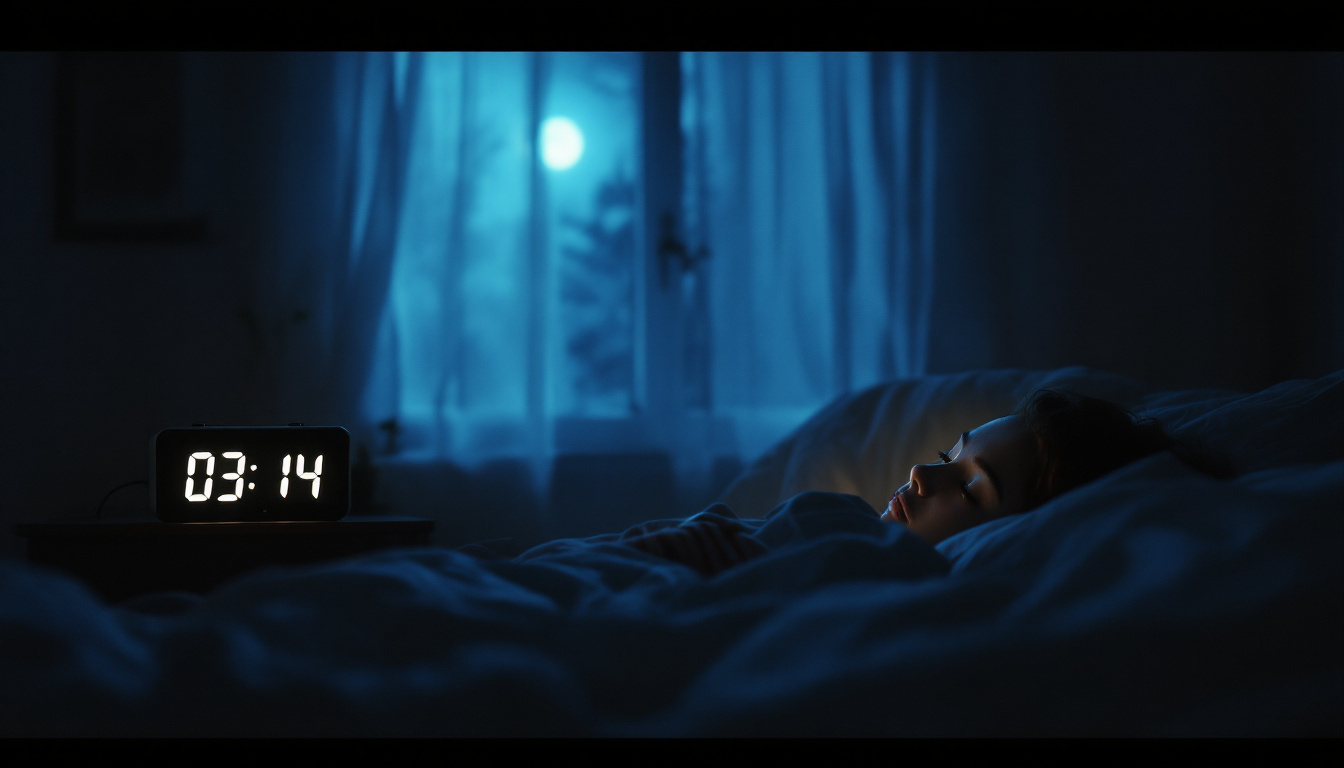
3:14 a.m. Wide awake. And the brain immediately kicks into gear.
You know the feeling. Your eyes open in the dark, you glance at the clock — 3:14 a.m. — and before you've even finished a thought, your brain is already off and running: tomorrow's meeting, that unpaid bill, a conversation from 2019. Your body is tired but your mind is racing, and with every minute that passes, the frustration grows: I have to fall asleep now, or tomorrow is ruined.
First, a reassuring signal: waking up during the night is not a defect in your sleep. It's part of how sleep works. Sleep is structured in cycles of roughly 90 minutes, and between cycles there are brief awakenings — most so short we never remember them. In a large population study, Ohayon, M. (2008, Journal of Psychiatric Research) found that nocturnal awakenings are very common; a substantial share of the population reports waking during the night.
There are even historical perspectives suggesting that sleeping straight through the night hasn't always been the norm. Historian Ekirch, A. R. (2005, At Day's Close) has described how people in pre-industrial times often slept in two segments with a waking period in between, and Wehr, T. A. (1992, Journal of Sleep Research) observed that participants given long dark nights spontaneously developed a similar two-part sleep pattern. This should be interpreted cautiously — it doesn't prove that segmented sleep is "more natural" — but it offers perspective: a middle-of-the-night awakening is not, in itself, a sign that something is broken.
So the problem is rarely the waking. The problem is not falling back asleep. This article dives deep into exactly that question. If you want the big picture of how sleep connects to the rest of your health — energy, mood, weight, immune function — you'll find it in our overview Sleep — how it connects to the rest of your health.
Why 3–4 a.m., specifically?
Many people describe their awakenings happening with eerie precision — almost always around 3 or 4 a.m. That's probably no coincidence, and the explanation seems to lie in the architecture of the night itself.
Deep sleep is not evenly distributed across the night. During the first hours, deep sleep dominates — the stage where the threshold for waking is highest. As the night progresses, sleep shifts toward lighter stages and REM sleep. By around 3–4 a.m., most people have already gotten the bulk of their deep sleep, and sleep is then, on average, lighter — which seems to make it easier to be woken by small things: a noise, a warm bedroom, a full bladder, or a stressful thought simmering below the surface. More on the structure of sleep cycles can be found in Sleep and recovery.
At the same time, the body begins preparing for morning. The stress hormone cortisol, which is at its lowest during the first part of the night, starts rising in the early morning hours as part of the normal circadian rhythm. The mechanisms aren't fully mapped out, but the combination — lighter sleep plus a body slowly shifting into gear — may be part of the explanation for why this particular time of night is so vulnerable.
In other words: 3–4 a.m. is the point in the night when sleep is at its most fragile. If you wake up then, and something keeps your brain running, the odds are higher that the awakening will be a long one.
What research links to nighttime awakenings
Research points to several factors that are associated with more frequent or longer nighttime awakenings. No single factor explains everything — often several work together.
Stress and racing thoughts. The most studied explanatory model for insomnia is called the hyperarousal model: people with sleep problems appear to be in a state of elevated physiological and cognitive activation — the body and brain are simply more "on" than they should be, even at night. Riemann, D. et al. (2010, Sleep Medicine Reviews) summarize the evidence for this model. Vgontzas, A. N. et al. (2001) also observed that chronic insomnia is associated with elevated activity in the HPA axis, the body's stress system. This lines up well with many people's experience: periods of stress and nights with 3 a.m. awakenings tend to arrive together. And once you're awake, the racing thoughts themselves become the obstacle to falling back asleep. Alcohol. A glass of wine in the evening can feel like it helps — you often fall asleep faster. But a review by Ebrahim, I. O. et al. (2013, Alcoholism: Clinical and Experimental Research) shows that alcohol is associated with more fragmented sleep during the second half of the night, while REM sleep is suppressed. Once the alcohol has been metabolized — often in the middle of the night — a kind of rebound with lighter, restless sleep is observed. The 3 a.m. awakening after an evening with wine is thus a well-documented pattern in the research. Age. Sleep changes over the lifespan. In a large meta-analysis, Ohayon, M. et al. (2004, Sleep) found that the proportion of deep sleep decreases and the number of nighttime awakenings increases with age. A 55-year-old waking more often than a 25-year-old is largely an expected pattern — not necessarily a problem that needs "fixing," as long as you fall back asleep and feel rested during the day. Temperature. The bedroom environment matters. Okamoto-Mizuno, K. & Mizuno, K. (2012, Journal of Physiological Anthropology) summarize research linking heat exposure during the night to more fragmented sleep and less deep sleep. A bedroom that's too warm — or a comforter that's too heavy — is one of the most overlooked factors behind awakenings during the later, lighter part of the night. Fluids and the bladder. Sometimes the explanation is far more down-to-earth: you wake up because you need to pee. Nocturia — needing to get up and urinate during the night — is described by Ancoli-Israel, S., Bliwise, D. & Nørgaard, J. P. (2011), among others, as a common and often underestimated factor behind disrupted sleep, particularly with advancing age. The point is that the awakening often feels like it's about stress or a sleep problem, when the actual trigger was the bladder — and the thoughts only started afterward.Taken together: the state of the research on what's connected to nighttime awakenings is promising and points in the same direction on several fronts, but much of it is based on observational data. What we can say is that stress, alcohol late in the evening, a warm bedroom, late fluid intake, and advancing age are all associated with more frequent or longer awakenings.
What to try when you wake up — and to wake up less often
Here's what research and clinical experience most often highlight. Framed as habits to try, not prescriptions.
Don't look at the clock. It sounds trivial, but it has actually been studied: Tang, N., Schmidt, D. & Harvey, A. (2007, Journal of Behavior Therapy and Experimental Psychiatry) found that clock-checking during the night was associated with more worry and worse sleep. Knowing it's 3:41 a.m. doesn't help you fall asleep — it just gives your brain fuel for the math of "only three hours left." Many people find it helps to turn the clock away or keep the phone out of reach. Get up if you can't fall back asleep. Lying in bed tossing and turning in frustration risks teaching your brain that the bed is a place for wakefulness and worry. A classic technique called stimulus control (Bootzin, R. 1972) does the opposite: if you've been lying awake for a while — get up, do something calm in dim light (read something boring, sit in an armchair), and only return to bed when sleepiness comes. The technique is a core component of CBT for insomnia (CBT-I), which in a meta-analysis by Trauer, J. et al. (2015, Annals of Internal Medicine) has been shown to have solid support for chronic sleep problems. Keep the bedroom cool and dark. Given the link between heat and fragmented sleep, a cool bedroom is a sensible baseline — many people find that around 60–66°F (16–19°C) works well, though the individual range varies. Darkness helps too, especially during the later part of the night when sleep is lighter and dawn light can creep in. Review evening fluids and alcohol. Tapering off fluid intake in the last hour or two before bed is common advice for nighttime bathroom trips. And given alcohol's documented link to fragmented sleep during the second half of the night, alcohol-free evenings are one of the easiest experiments to run — many people notice a difference after just a few nights. Deal with the thoughts during the day instead of at night. If racing thoughts are what keep you awake, many people find that a short "worry session" earlier in the evening — writing down what's spinning, ideally with a simple plan for the next step — means the thoughts don't have to be processed at 3 a.m. This aligns with the hyperarousal model: what lowers overall activation during the day also seems to benefit the night. More on winding down and sleep hygiene in general can be found in Sleep and recovery. When should you contact a healthcare provider? Take the problem seriously if the awakenings are persistent — several nights a week over an extended period — and affect how you feel and function during the day. Seek medical care especially if there are signs of sleep apnea (loud snoring, pauses in breathing noticed by a partner, pronounced daytime sleepiness) or if the awakenings are connected to low mood or anxiety. CBT-I, which has strong research support, is offered through healthcare providers and telehealth services. If you have symptoms that concern you — contact a healthcare professional. Cipoli is not a substitute for medical advice. What does your data say? Nighttime awakenings often have their roots in what you do during the day and evening — stress, alcohol, evening routines, bedroom environment. Cipoli's assessment helps you see how your habits connect, and where the biggest opportunities lie.
Cipoli analysis
Cipoli's interpretationIn Cipoli's model, nighttime awakenings are rarely an isolated sleep issue — they are often a mirror of the day. In our assessment, we therefore look at sleep alongside the factors research links to fragmented sleep: stress levels and the ability to wind down, alcohol habits and what time of day alcohol is consumed, evening routines like screen time and late meals, and the bedroom environment. The pattern we often see is that people who score high on stress and low on recovery also report more awakenings — which aligns well with the hyperarousal model. The interesting part is that the interventions then rarely lie in the bed itself, but in what happens in the hours before: how the evening winds down, what's being consumed, and how warm and bright the bedroom is. Cipoli's observations are just that — observations, not scientific conclusions — but they can help you see which of your own habits tend to co-vary with your nights.

Your personal connection
Based on your profileSources and further reading
- Ohayon, M. (2008). Nocturnal awakenings and comorbid disorders in the American general population. Journal of Psychiatric Research
- Ekirch, A. R. (2005). At Day's Close: Night in Times Past. W. W. Norton & Company
- Wehr, T. A. (1992). In short photoperiods, human sleep is biphasic. Journal of Sleep Research
- Riemann, D. et al. (2010). The hyperarousal model of insomnia: a review of the concept and its evidence. Sleep Medicine Reviews
- Vgontzas, A. N. et al. (2001). Chronic insomnia is associated with nyctohemeral activation of the hypothalamic-pituitary-adrenal axis. Journal of Clinical Endocrinology & Metabolism
- Ebrahim, I. O. et al. (2013). Alcohol and sleep I: effects on normal sleep. Alcoholism: Clinical and Experimental Research
- Ohayon, M. et al. (2004). Meta-analysis of quantitative sleep parameters from childhood to old age in healthy individuals. Sleep
- Okamoto-Mizuno, K. & Mizuno, K. (2012). Effects of thermal environment on sleep and circadian rhythm. Journal of Physiological Anthropology
- Ancoli-Israel, S., Bliwise, D. & Nørgaard, J. P. (2011). The effect of nocturia on sleep. Sleep Medicine Reviews
- Tang, N., Schmidt, D. & Harvey, A. (2007). Sleeping with the enemy: clock monitoring in the maintenance of insomnia. Journal of Behavior Therapy and Experimental Psychiatry
- Bootzin, R. (1972). Stimulus control treatment for insomnia. Proceedings of the American Psychological Association
- Trauer, J. et al. (2015). Cognitive behavioral therapy for chronic insomnia: a systematic review and meta-analysis. Annals of Internal Medicine