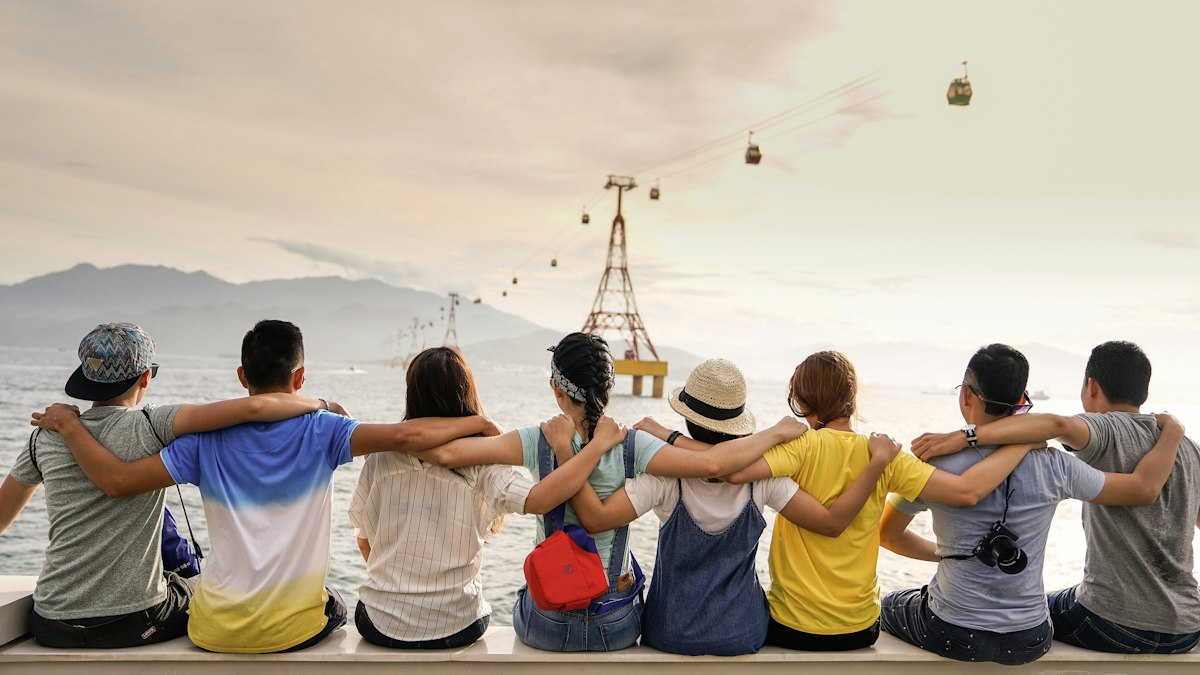
Why social contact?
Humans are social animals. Our brains evolved over hundreds of thousands of years in small groups of 50 to 150 individuals, where social belonging was just as vital as food and water. Being excluded from the group literally meant death. That is why the brain responds to social isolation with the same stress system as physical pain — it activates the same brain regions and produces the same stress hormones. In modern times, we have built societies where it is possible to live physically alone. But our biology has not kept up. The body still interprets loneliness as an existential threat and responds with chronically elevated cortisol, increased inflammation, and weakened immune function. What once was a survival reflex — seeking the group — has become a silent health crisis. The solution does not need to be complicated: one scheduled activity per week creates a structure that breaks the pattern.
What the research says
Holt-Lunstad's 2010 meta-analysis (PLOS Medicine) analyzed 148 studies with 308,849 participants over an average of 7.5 years. The result: strong social relationships increased the chance of survival by 50%. In a follow-up study in 2015 with 3.4 million participants, she found that social isolation, loneliness, and living alone increased the risk of premature death by 26 to 32%.
Sheldon Cohen at Carnegie Mellon University exposed 276 healthy adults to cold viruses. Those with more social contacts and a more varied social network were 4 times less likely to get sick. The mechanism: social belonging lowers chronic inflammation and strengthens the immune system's ability to fight viruses.
A large longitudinal study published in The American Journal of Psychiatry showed that strong social ties reduce the risk of depression by 50%. The mechanisms are multiple: social contact releases oxytocin (the bonding hormone), stimulates the serotonin system, and provides a sense of meaning and belonging that buffers against low mood and anxiety.
Step by step: Build the habit in 4 weeks
The key is to move from spontaneity to structure. Scheduled activities happen — spontaneous plans fall through.
Pick someone you haven't seen in a while. Send a concrete suggestion: 'Coffee on Wednesday at 3 pm?' Keep the bar low — it does not have to be dinner or a party. A 30-minute coffee is enough. What matters is that it happens, not that it is impressive. Put it in your calendar as a meeting you will not cancel.
Suggest a regular time: 'Should we do this every Wednesday?' Research shows that regularity is required to build deeper relationships — sporadic contact keeps relationships alive, but regular contact deepens them. Set a reminder every Sunday to book the next week's activity if it is not already scheduled.
Try different forms of social activity: a walk in nature, coffee at a cafe, a shared dinner, a sport or hobby. Variety has a dual effect: it prevents monotony and creates richer shared memories. Studies show that shared experiences — especially novel and challenging ones — strengthen social bonds more than routine meetings.
Choose one person to invest extra in. Invite them to a longer dinner, ask deeper questions, share something personal. Meanwhile, keep other contacts alive with short check-ins (a message, a brief coffee). Research shows that it is not the number of friends that protects health — it is the depth of 2 to 3 key relationships, combined with a broader network.
Overcoming obstacles
Introversion does not mean you need less social contact — it means you need the right kind. Research shows that introverts thrive on deeper one-on-one conversations, in calm settings, with longer breaks in between. A walk with a close friend in nature can be more energizing for you than a party. Adjust the format, not the frequency.
Time is a prioritization problem, not a resource problem. You find time for what you prioritize. Schedule it as a meeting in your calendar — if you had a doctor's appointment at 3 pm on Wednesday, you would not cancel it. Give social time the same status. And it does not need to take long: a 30-minute coffee has a measurable effect on stress hormones and mood.
Building new relationships requires three things: repeated contact, shared activity, and vulnerability. Studies show that it takes about 50 hours of shared time to go from acquaintance to friend, and 200 hours for close friendship. Start with an activity group — sports, choir, book club, volunteering. The shared activity provides conversation topics and removes the pressure of just talking.

Cipoli-analys
What does the data show about weekly social activity and health?Here we will show a group comparison between Cipoli users who have regular social activity and those who do not.
- ›Comparison of loneliness, stress levels, and life satisfaction
- ›Relationships between social frequency, sleep, and immune health
- ›Correlations with depression, anxiety, and mood
We need more responses to create meaningful analyses. The more people who map their health, the better and more reliable the analyses become.

Your personal connection
Current index → potential with the habitSummary
- Social isolation is linked to the same elevated risk of premature death as major risk factors — social contact is a health habit, not a luxury.
- Strong social ties are linked to +50% survival, lower depression, and a stronger immune system.
- The key is structure: one scheduled activity per week happens, while spontaneous plans fall through.
- Build the habit over 4 weeks — book it, make it recurring, vary the format, and deepen one relationship.