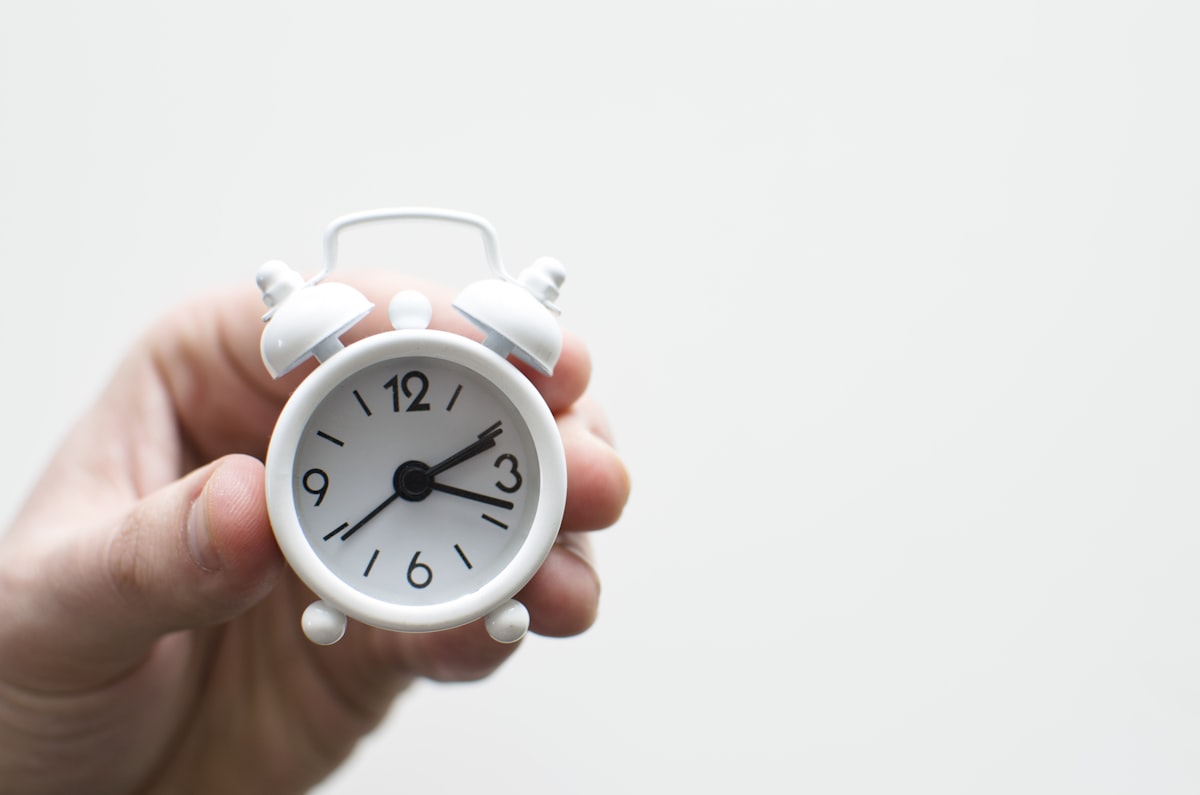
Your circadian rhythm: a biological clock
Deep inside your brain sits the suprachiasmatic nucleus (SCN) — a tiny cluster of about 20,000 nerve cells that serves as the body master clock. It controls when you feel sleepy, when you wake up naturally, when cortisol rises in the morning, and when melatonin production begins. But the SCN is calibrated by external cues — primarily light and regularity. If you go to bed at 11 PM one night, 1 AM the next, and 10 PM the night after, your clock gets conflicting signals, and the result is shallow sleep, groggy mornings, and erratic energy. The good news: the clock adapts quickly. After just 7 to 10 days of a consistent schedule, melatonin releases at the right time and you often wake up naturally refreshed — seconds before the alarm goes off.
What the research says
A study in the Journal of the American Heart Association (2023) tracking 60,977 participants over 7 years found that people with irregular sleep schedules had a 27% higher risk of cardiovascular events compared to those who kept consistent times — regardless of total sleep duration.
Harvard researchers tracked students sleep patterns with activity trackers. Those with consistent sleep times (plus or minus 30 min variation) had significantly higher grades than those with irregular sleep — despite getting the same total sleep. Consistency trumped quantity.
Research in Current Biology showed that each hour of variation in sleep timing (social jet lag) increases the risk of metabolic syndrome by 11%. Irregular sleep disrupts insulin sensitivity and leptin production — hormones that control hunger and fat burning.
Stabilize your rhythm in 3 steps
You do not need to make a dramatic change. The most important rule: wake up at the same time every day — your bedtime will naturally follow. Expect about 4 weeks before it becomes automatic.
Pick a fixed wake time that works every day — yes, even weekends. Set the alarm and get up no matter how late you went to bed. It feels tough on days 2 to 3, but the clock starts adjusting right away. 15 minutes of morning light outdoors amplifies the effect.
Now that your wake time is locked in, choose a bedtime that allows 7 to 8 hours of sleep. Start winding down 30 minutes before — dim the lights and put screens away. Go to bed at your set time even if you do not feel sleepy. Tip: set a bedtime alarm on your phone.
The weekend is the critical test: keep your wake time (30 min deviation max). To make up for lost sleep, go to bed 30 min earlier instead of sleeping later. By week 4 most people wake up on their own just before the alarm. Stay strict at least 5 out of 7 days.
The weekend trap — and how to avoid it
If you wake up at 7 AM on weekdays but 10 AM on weekends, you have given your body a 3-hour jet lag — every week. Mondays feel heavy not because you did not sleep enough, but because your clock is shifted. Keep your wake time on weekends too.
Researchers recommend no more than 30 minutes of deviation from your usual wake time — even on weekends. Sleep in 30 minutes if you want, but no more. Instead, compensate by going to bed 30 minutes earlier the night before.
A cup of coffee in the morning boosts the cortisol wake-up response, but caffeine after 2 PM blocks adenosine and delays your natural sleepiness. The rule: coffee in the morning, and in the afternoon switch to water, tea, or decaf.

Cipoli-analys
What does the data show about circadian rhythm and health?Here we will show a group comparison between Cipoli users with a consistent circadian rhythm versus those with irregular sleep — and how it relates to sleep quality and energy over time.
- ›Sleep Index comparison and energy levels
- ›Relationship between consistent sleep timing and morning energy
- ›Correlations with mood, productivity, and stress
We need more responses to create meaningful analyses. The more people who map their health, the better and more reliable the analyses become.

Your personal connection
Current index → potential with the habitSummary
- Your internal clock (the suprachiasmatic nucleus) needs consistent signals — the same sleep and wake time is the strongest one.
- Consistency beats quantity: irregular timing raises cardiovascular risk by 27% and metabolic syndrome risk by 11% per hour of variation.
- The most important rule is to wake at the same time every day — your bedtime will follow.
- The clock resets in 7 to 10 days; keep your wake time within 30 minutes even on weekends to avoid social jet lag.